Length-Weight Relationships of 10 Fish Species from the Southern Black Sea, Turkey
Tuncay Yesilcicek, Ferhat Kalayci, Cemalettin Sahin
Recep Tayyip Erdoğan University, Faculty of Fisheries, 53100, Rize, Turkey
- *Corresponding Author:
- Yeşilçiçek T
Recep Tayyip Erdoğan University, Faculty of Fisheries, 53100, Rize, Turkey
E-mail: tuncay_yesilcicek@hotmail.com
Received: 24.11.2014 / Accepted: 03.01.2015 / Published online: 07.01.2015
Abstract
In this study, the length-weight relationships of 10 fish species collected with gill and trammel nets during June 2010 and June 2011 from the Eastern Black Sea coasts of Turkey, were investigated. The b values of the length-weight relationships for 10 fish species ranged from 2.549 to 3.301 with a mean value of 3.070 ± 0.039 (S.E.). Five, four and one species showed isometric, positive allometric and negative allometric growth, respectively. The differences in b values of male and female of Engraulis encrasicolus, Merlangius merlangus, Mullus barbatus, Scorpaena porcus, Solea solea, Spicara maena and Uranoscopus scaber were significant. (ANCOVA, P < 0.05).
Keywords
Length-weight relationship, fish species, growth type, Southern Black Sea.
Introduction
Length-weight data are widely used to gather information on biology of fishes. In general, this and other different kind of analysis have become one of the standard methods used in fisheries biology (Le Cren, 1951; Kohler et al., 1995). These data are necessary in estimation of the growth rates, age and length composition of fish populations (Kohler et al., 1995). In fish, size is generally more biologically relevant than age, mainly because several ecological and physiological factors are more size-dependent than age. Consequently, variability in size has important implications in diverse aspects of fisheries science and population dynamics (Erzini, 1994). A length- weight relationship (LWR) presents useful information for understanding the relative condition of fish stocks. In addition, LWR is used in various important applications for evaluation of fish stocks (Ricker, 1968; Pauly, 1993; Garcia et al., 1998; Haimovici and Velasco, 2000). Some of these applications include assessment of available fish stock and comparison of fish populations existing in different regions (Petrakis and Stergiou, 1995). Furthermore, length-weight (L-W) relationships have special importance in fisheries research because they (a) are used to convert growth-in-length equations to growth-in-weight in stock assessment models, (b) allow the estimation of the biomass of a species from length frequency distributions, (c) the condition of fish; and (d) are useful for between region comparisons of life histories of a certain species (Gonçalves et al., 1997; Binohlan and Pauly, 2000).
The aim of this study is to determine the length-weight relationships of 10 fish species, most of which are demersal species caught by gill and trammel nets in the Eastern Black Sea of Turkey. The reported results may contribute to management of fisheries resources in the area.
Materials and Methods
Samples were collected from the monthly fishing trials performed between June 2010 and June 2011 in the Eastern Black Sea coasts of Turkey. Fish specimens were collected using gill and trammel nets at depths ranging from 8 m to 95 m. The length of gill and trammel nets consisting of five different mesh sizes (16, 17, 18, 20, 22 mm bar length) were 639 m and 590 m, respectively. The total length (TL) and weight (W) of each fish were measured to the nearest 0.1 cm and 0.01 g, respectively. The relationships between length and weight is expressed by W = a × Lb, which was converted to linear form as lnW = lna + b lnL, where W is total body weight (g), L is the total length (cm), a = intercept and b = slope regression coefficients (Ricker, 1973; King, 2007). When b values equal to 3, less than and higher than 3, then fish species in questions is said to show isometric, negative allometric and positive allometric growth, respectively. (Bagenal and Tesch, 1978; Santos et al., 2002). The b value for each species was tested with a t-test at the 0.05 level of significance to verify whether it was significantly different from the predicted values for isometric growth (Morey et al., 2003). For this test, the following equation was used (Sokal and Rohlf, 1987);
ts = (b - 3) / sb,
Where ts is the value of t test, b is the slope and sb is the standard error of b. Analysis of covariance (ANCOVA) was used to determine whether there was significant difference in slopes between sexes (Zar, 1999).
Results and Discussion
A total of 5353 individuals belonging to 10 fish species sampled during in the study. The sample size ranged from 11 individuals for Parablennius gattorugine to 2705 for Merlangius merlangus euxinus. Table 1 presents the sample sizes, the minimum and maximum L-W values, the coefficients of determination (r2), regression coefficients and the growth types of each species. In order to compare the results of the present study with those of other length-weight relationship studies in different areas were presented in Table 2. The length-weight relationship parameter, b value, generally ranges between 2 and 4 (Bagenal and Tesch, 1978), often close to 3 (Jobling, 2002). The b values ranged from 2.549 for E. encrasicolus to 3.301 for S. porcus with mean value of 3.070 ± 0.039 (S.E.). The coefficient of determination (r2) value was calculated 0.901 for S. solea and 0.974 for E. encrasicolus with mean value of 0.935 ± 0,007 (S.E.). Five, four and one species showed isometric, positive allometric and negative allometric growth, respectively. Analysis of covariance (ANCOVA) showed that the differences in slopes(b values) between the sexes for E. encrasicolus, M. merlangus, M. barbatus, S. porcus, S. solea, S. maena and U. scaber were significant (P < 0.05).
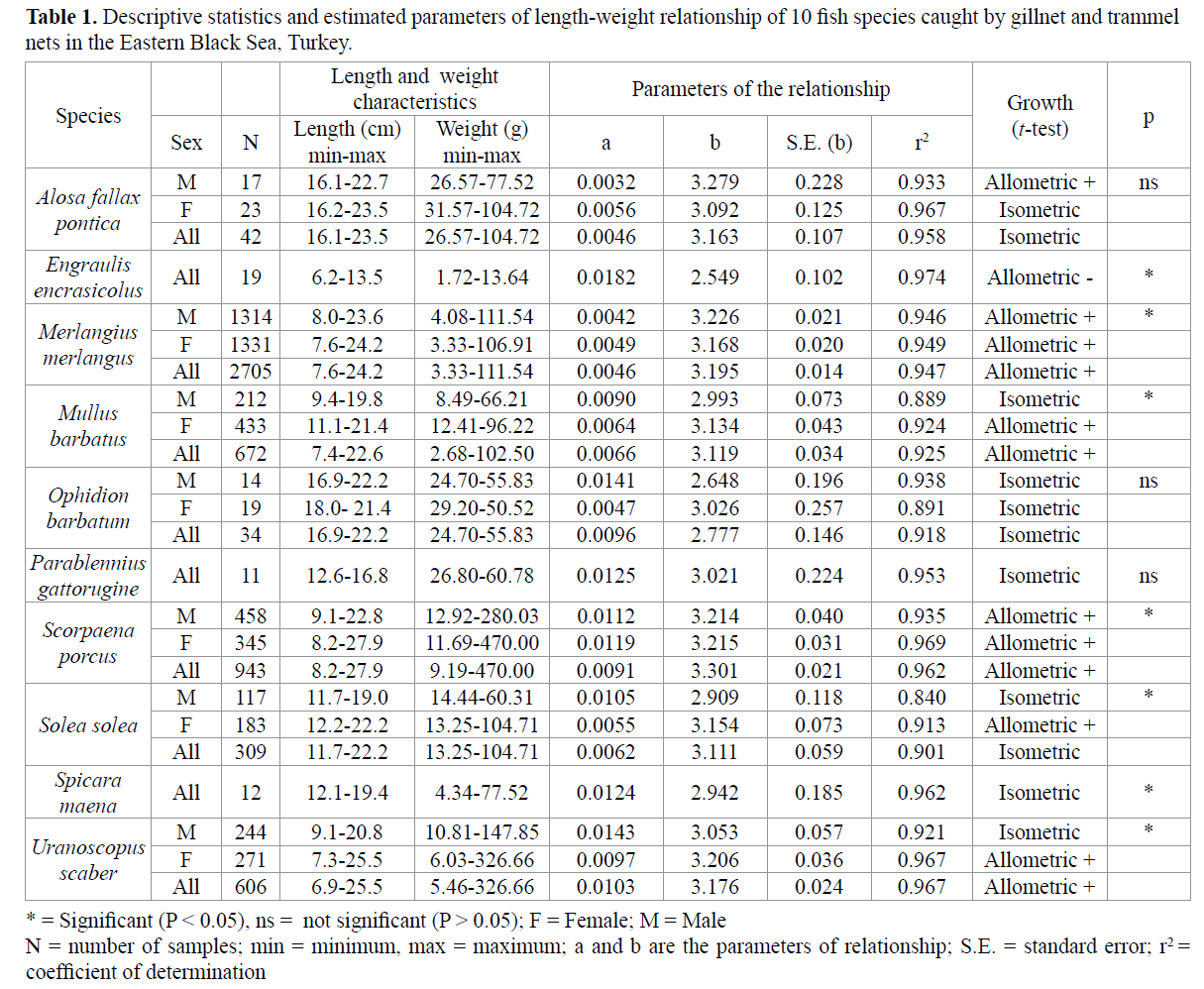
Table 1. Descriptive statistics and estimated parameters of length-weight relationship of 10 fish species caught by gillnet and trammel nets in the Eastern Black Sea, Turkey.
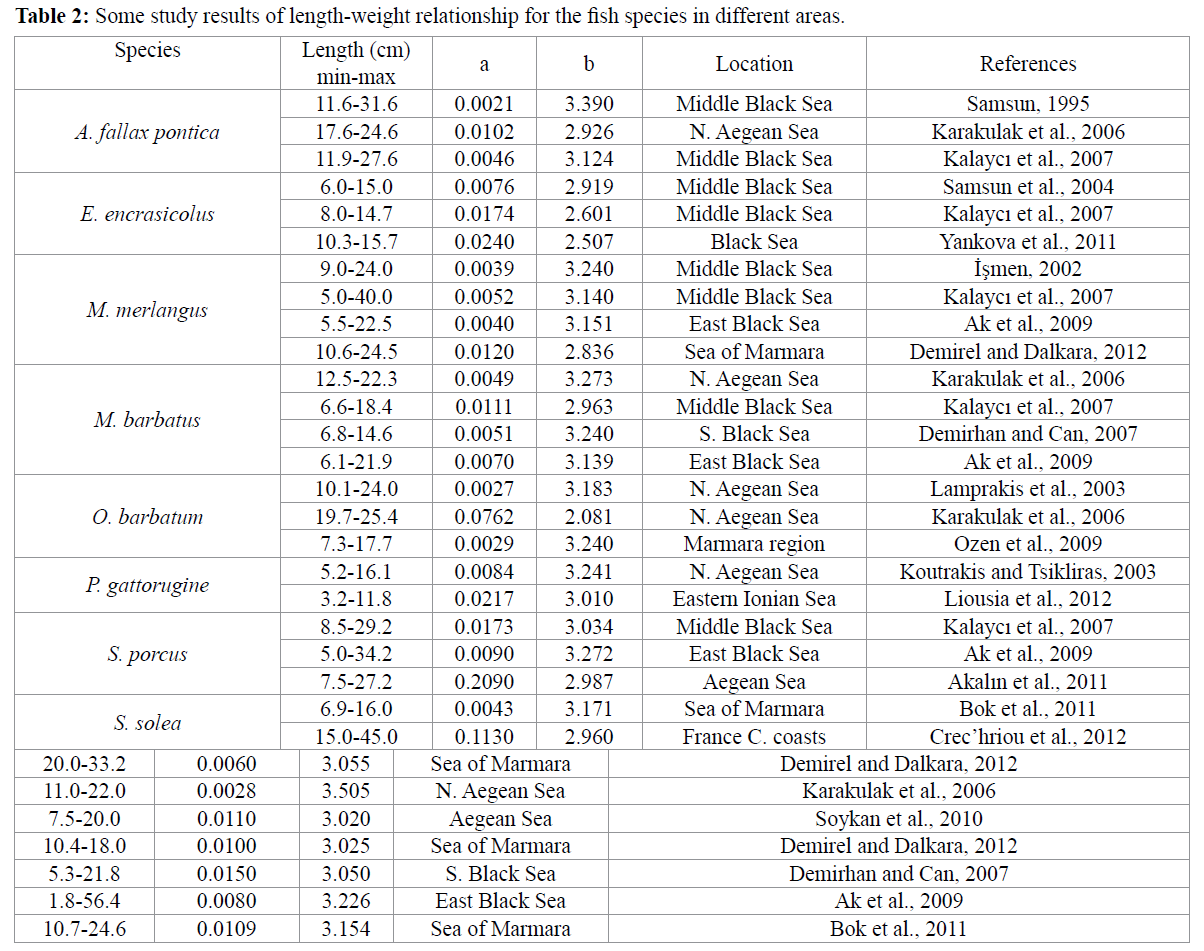
Table 2: Some study results of length-weight relationship for the fish species in different areas.
The length-weight relationship varies among species according to genetically body shape and to the condition of individuals of a fish species. The condition sometimes reflects the presence of nutrients and the growth before in the sampling week, but condition is variable and dynamic. Individuals within the same sampling considerably vary, however, the average condition of individuals in each population differs according to years and seasons. For some species, sex and gonad development are important variables (Schneider et al., 2000). Also, many factors such as habitat, diet, locality, and stomach fullness are the other important variables that affect the length–weight relationship in fishes (Esmaeili and Ebrahimi, 2006).
Acknowledgements
This study was supported by the Scientific Research Fund of Recep Tayyip Erdoğan University (RTEUSRF) with project number 2010. 103.03.1. We are grateful to Yusuf Ceylan and boat owner for all of their cooperation and help during the data collection.
References
Ak, O., Kutlu, S., Aydın, İ., (2009). Length-Weight Relationship for 16 Fish Species From the Eastern Black Sea, Türkiye, Turkish Journal of Fisheries and Aquatic Sciences, 9: 125- 126.Akalın, S., İlhan, D., Ünlüoğlu, A., Tosunoğlu, Z., Özaydın, O., (2011). Length-weight relationship and metricmeristic characteristics of two scorpion fishes (Scorpaena notata and Scorpaena porcus) in İzmir Bay. Journal of FisheriesSciences.com., 5: 291-299. doi: 10.3153/jfscom.2011033
Bagenal, T.B. and Tesch, F.W., (1978). Age and growth. In: Bagenal T.B.( Ed.), Methods for Assessment of Fish in Freshwaters. 3rd Edition. Oxford, UK: Wiley-Blackwell, p. 101–136.
Binohlan, C. and Pauly, D., (2000). The lengthweight table. In Fishbase, Froese R and Pauly D, (Eds). Concepts, design and data sources. Manila, Philippines: ICLARM, p. 131– 134.
Bok, T. D., Gokturk, D., Kahraman, A. E., Alicli, T. Z., Acun, T. and Ateş, C., (2011). Length-Weight Relationships of 34 Fish Species from the Sea of Marmara, Turkey, Journal of Animal and Veterinary Advances,10: 3037-3042. doi: 10.3923/javaa.2011.3037.3042
Crec'hriou, R., Neveu, R. and Lenfant, P., (2012). Length–weight relationship of main commercial fishes from the French Catalan coast. Journal of Applied Ichthyology, 28: 861–862. doi: 10.1111/j.1439-0426.2012.02030.x
Demirel, N. and Dalkara, E. M., (2012). Weight−length relationships of 28 fish species in the Sea of Marmara. Turkish Journal of Zoology, 36: 785-791. doi: 10.3906/zoo-1111-29
Demirhan, S. A., Can, M. F., (2007). Length–weight relationships for seven fish species from the southeastern Black Sea. Journal of Applied Ichthyology, 23: 282–283. doi: 10.1111/j.1439-0426.2007.00835.x
Erzini, K. 1994. An empirical study of variability in length-at-age of marine fishes, Journal of Applied Ichthyology, 10: 17–41. doi: 10.1111/j.1439-0426.1994.tb00140
Esmaeili, H. R. and Ebrahimi, M., (2006). Length–weight relationships of some freshwater fishes of Iran. Journal of Applied Ichthyology, 22: 328–329. doi: 10.1111/j.1439-0426.2006.00653.x
Garcia, C. B., Duarte, J. O., N, Sandoval., Schiller, D. V., Melo, G., Navajas, P., (1998). Length–weight relationships of demersal fishes from the Gulf of Salamanca, Colombia, Naga, the ICLARM Quarterly, 21: 30–32.
Gonçalves, J. M. S., Bentes, L., Lino, P. G., Ribeiro, J., Canario, A. V. M. and Erzini, K., (1997). Weight-length relationships for selected fish species of the small-scale demersal fisheries of the south and south-west coast of Portugal, Fisheries Research, 30: 253-256. doi: 10.1016/S0165-7836(96)00569-3
Haimovici, M. and Velasco, G., (2000). Length-weight relationships of marine fishes from southern Brazil, Naga, the ICLARM Quarterly, 23: 19-23.
Işmen, A., (2002). A preliminary study on the population dynamics parameters of whiting (Merlangius merlangus euxinus) in Turkish Black Sea coast waters, Turkish Journal of Zoology, 26: 157-166.
Jobling, M., (2002). Environmental Factors and Rates of Development and Growth. In: Hart PJB, Reynolds JD, (Eds). Handbook of Fish Biology and Fisheries, Vol:1 Fish Biology, Blackwell Science Ltd, p. 97-122.
Kalaycı, F., Samsun, N., Bilgin, S., Samsun, O., (2007). Length- Weight Relationship of 10 Fish Species Caught by Bottom Trawl and Midwater Trawl from the Middle Black Sea, Turkey, Turkish Journal of Fisheries and Aquatic Sciences,7: 33-36.
Karakulak, F. S., Erk, H., Bilgin, B., (2006). Length-weight relationships for 47coastal fish species from the Northern Aegean Sea, (Turkey), Journal of Applied Ichthyology, 22: 274-278. doi: 10.1111/j.1439-0426.2006.00736.x
King, M., (2007). Fisheries Biology, assessment and management. 2nd edition., Wiley-Blackwell Scientific Publications, Oxford, 400 pp.
Kohler, N., Casey, J. and Turner, P., (1995). Length-weight relationships for 13 species of sharks from the western north Atlantic, Fishery Bulletin, 93(2): 412-418.
Koutrakis, E. T. and Tsikliras, A. C., (2003). Length–weight relationships of fishes from three northern Aegean estuarine systems (Greece), Journal of Applied Ichthyology, 19: 258– 260. doi: 10.1046/j.1439-0426.2003.00456.x
Lamprakis, M. K., Kallianiotis, A. A., Montopoulos, D. K., Stergion, K. I., (2003). Weight–length relationships of Fishes discarded by trawlers in the North Aegean Sea, Acta Ichthyologica Et Piscatoria, 33: 145-152.
Le Cren, E. D.. (1951). The length-weight relationship and seasonal cycle in gonad weight and condition in the perch (Perca fluviatilis). Journal of Animal Ecology, 20: 201-209.
Liousia, V., Batziakas, S., Panagiotou, N., Daouti, I., Koutrakis, E., Leonardos, I. D., (2012). Length–weight relations of 22 fish species from the littoral zone of the Eastern Ionian Sea, Greece, Acta Ichthyologica Et Piscatoria, 42: 69–72. doi: 10.3750/AIP2011.42.1.09
Morey, G., Morantai, J., Massut, E., Grau, A., Linde, M., Riera, F., Morales, N. B., (2003). Weight-length relationships of littoral to lower slope fishes from the western Mediterranean, Fisheries Research, 62: 89–96. doi: 10.1016/S0165-7836(02)00250-3
Ozen, O., Ayyildiz, H., Oztekin, A. and Altin, A., (2009). Length–weight relationships of 17 less-studied fish species from Çanakkale, Marmara region of Turkey. Journal of Applied Ichthyology, 25: 238–239. doi: 10.1111/j.1439- 0426.2009.01235.x
Pauly, D., (1993). Fishbyte Section Editorial. Naga, the ICLARM Quarterly, 16: 26.
Petrakis, G. and Stergiou, K. I., (1995). Weight-length relationships for 33 fish species in Greek waters. Fisheries Research, 21:4 65–469. doi: 10.1016/0165-7836(94)00294-7
Ricker, W. E., (1968). Methods for assessment of fish production in freshwaters. International Biological Programme No.3, Blackwell Scientific Publications, London. 313 p.
Ricker, W. E., (1973). Linear regressions in fishery research. Journal of the Fisheries Research Board of Canada, 30(3): 409–434.
Santos, M. N., Gaspar, M. B., Vasconcelos, P., Monteiro, C. C., (2002). Weight-length relationships for 50 selected fish species of the Algarve (southern Portugal), Fisheries Research, 59: 289–295. doi: 10.1016/s0165-7836(01)00401-5
Samsun, O., (1995). The weight-length relationship of the shads (Alosa pontica Eichw., 1938) in the mid of the Turkish Black Sea. E.Ü Su Ürünleri Dergisi, 12: 15-21.
Samsun, O., Samsun, N. and Karamollaoğlu, A., (2004). Age, growth and mortality rates of the European anchovy (Engraulis encrasicolus Linnaeus, 1758) off the Turkish Black Sea coast. Turkish Journal of Veterinary and Animal Sciences, 28: 901-910.
Schneider, J. C, Laarman, P. W. and Gowing, H., (2000). Lengthweight relationships. In: Schneider JC, (Ed). Manual of fisheries survey methods II: with periodic updates. Michigan Department of Natural Resources, Fisheries Special Report 25, Ann Arbor.
Sokal, R. R., Rohlf, F. J,. (1987). Introduction to Biostatistics. 2nd Edition. New York, USA: Freeman.
Soykan, O., İlkyaz, A. T., Metin, G., Kınacıgil, H. T., (2010). Growth and reproduction of blotched picarel (Spicara maena Linnaeus, 1758) in the central Aegean Sea, Turkey, Turkish Journal of Zoology, 34: 453-459. doi: 10.3906/zoo-0903-29
Yankova, M., Pavlov, D., Raykov, V., Mihneva, V., Radu, G., (2011). Length-weight relationships of ten fish species from the Bulgarian Black Sea waters. Turkish Journal of Zoology, 35: 265-270. doi:10.3906/zoo-0912-44
Zar, J. H., (1999). Biostatistical Analysis. 4th edition. Englewood Cliffs, New Jersey: Prentice Hall.
Open Access Journals
- Aquaculture & Veterinary Science
- Chemistry & Chemical Sciences
- Clinical Sciences
- Engineering
- General Science
- Genetics & Molecular Biology
- Health Care & Nursing
- Immunology & Microbiology
- Materials Science
- Mathematics & Physics
- Medical Sciences
- Neurology & Psychiatry
- Oncology & Cancer Science
- Pharmaceutical Sciences